The current church eschatological paradigm asserts that we are living in the end times because of the widespread chaos and increasing crisis across the earth. In this thinking system, it is presumed that the earth was “perfect” until Adam sinned. Accordingly, the term “perfect paradise” is used to describe this presumed initial perfect state of the earth before man’s rebellion.
The “increasing crisis” paradigm argues that the world is getting darker and darker, worse and worse, that there is nothing man can do about it. As far as this mentality is concerned, the only solution is the second return of Jesus who will then personally put an end to this widespread chaos.
But if we carefully study the Genesis account without human presumptions, then we shall discover the truth that is quite sobering and very confronting at the same time to our current approach.
In Genesis 1 God does not declare the world “perfect”; he declares it “very good” (Gen. 1:31). On the one hand, associating “good” and “perfect” sounds like a reasonable assumption. But is “very good” the same thing as “perfect?”
In the Hebrew Bible “good” is not perfect. The Hebrew phrase translated as “very good” in Genesis 1 is “meod tob” and describes the condition of “being fit and ready to achieve the intended purpose.”
On the other hand, one of the words used for “perfect” is the Hebrew word “miklal” and which means “completeness;” perfection (Psalm 50:2).
Therefore, very good does not mean perfect. This can be further understood in the chaos imagery in the creation account in Genesis 1; we see uncertainty/ unpredictability built into creation— the entire creation was formless, void, and untamed.
In Genesis 2:5, this situation is recapitulated on a smaller scale. God begins to address this situation by creating man. Then, after creating the man, he plants a Garden in Eden and places the man within it.
Eden was a divine sanctuary, the place where God walked in the midst of mankind, and the template for the solution to the problem of the wider world. The Garden was walled or hedged and there was limited access to it, enabling those within it to defend it against intrusion (cf. Genesis 3:24).
In planting the Garden, God establishes boundaries within the land, preventing unauthorized access and dividing one zone from others— gardens were usually walled enclosures, places of refuge from the untamed world. If the outer world did not include some danger (chaos), what need would there be for a walled refuge?
If “very good” was supposed to mean “perfect” then why was Adam told to “subdue” the earth before sin? If the earth was “perfect” what was there to “subdue” or bring under control?
Interestingly, the instruction to “subdue” and “rule” is intriguing, because God had just created the heavens and the earth, placing His stamp of approval on it: He saw that it was “very good.” How can you get any better than that? Why would it need to be “subdued” and “ruled?” And remember, this mandate was given before the created world had been affected by the disastrous choices made by mankind in the Garden, as recorded in Genesis 3.
All the earth was not Eden, yet somehow we presume that. There is no reason that chaos, death, and disaster could not have been part of the conditions outside Eden – in fact, it’s really essential, since Eden was designed to be the ultimate contrast – it was the lone place on the planet where there was only life, not death, harmony and not chaos, peace and not disaster because that was where God was.
It was from this context of the Garden, that God commanded human beings to “fill the earth and subdue it.” The word “subdue” according to the Hebrew is not a “wimpy” word, it is “kabas,” and in all its other occurrences in Scripture (about twelve in all) it is used as a term indicating “strong action in the face of opposition, enmity or evil.”
Thus, we read for example— the land of Canaan was “subdued” before Israel, though the Canaanites had chariots of iron (Josh. 17:8; 18:1); weapons of war are “subdued,” so are iniquities (Zech. 9:15; Micah 7:19).
The word is never used in a mild sense. It indicates that Adam was to engage a world that was dangerous, wild and untamed, hence, Adam was charged to exercise a genuinely civilizing role. He was to subdue an imperfect world.
As a King-Priest placed within the Garden, man was charged with the task of guarding and serving the enclosed Sanctuary in the midst of which God walked. His responsibility being to maintain the “tamed” and “domesticated” character of Eden by upholding, defending, and enforcing her boundaries.
As he upheld the order of the Eden, it would provide a model for him to bring perfection into God’s “good” but untamed outer world. His mandate was to make the world into a Garden and the Garden into a glorious City— the perfect (golden-cubed) city that we see in Revelation 21. He was to learn within and from the order of God’s own creative work, so that he could engage in creative work as God’s imager in the world.
Under the Kingdom Purpose Paradigm, God’s labeling the creation “very good” is a value judgment about the where and why of His eternal plan. In this perspective, “very good” means “perfectly suited to the purpose for which God intended it.”
Under the Kingdom Purpose Paradigm, we recognize that the earth was created indeed very good, yet imperfect. It was a world in its infancy— an immature world; and therefore, there remained a task within the world that still needed to be done— the task of fruitfulness, multiplicity; of filling the earth, and subduing it.
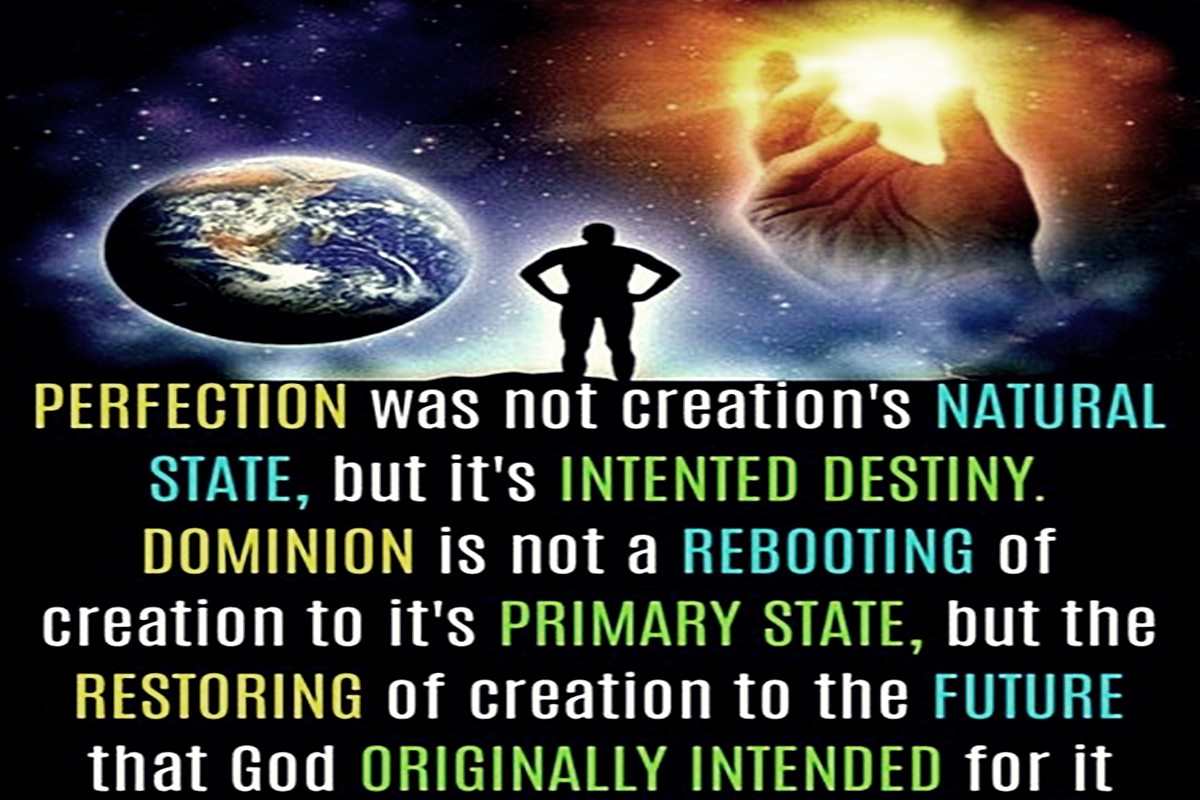
Perfection was not creation’s natural state, but its intended destiny. Therefore, dominion is not a ‘rebooting’ of creation to its primary state, but the restoring of creation to the future that God originally intended for it.
In His perfect omniscience and foreknowledge, God designed the world to be this way. He knew exactly how He would use it to serve His Eternal purpose. Where the current church eschatological paradigm view insists that chaos and crisis defy God’s intentions, the Kingdom Purpose Paradigm view recognizes their place in God’s unfolding eternal purpose narrative.
The untamed world outside the Garden was designed in exactly the way God needed it to be in order to achieve his ultimate purpose through the dominion of man— his divine agent.
God’s plan for a new heaven and a new earth is not a plan ‘B’ in reaction to man’s “unforeseen” rebellion. Instead, it is a culmination, the completion and perfection of the dominion process in accordance with God’s eternal and perfect purpose for the earth from before the beginning of time! Selah!
Read Revelation 21!